

In this article:
What a limiter actually does, in plain terms
How analog and digital limiting differ, and what top mastering engineers say about it
The order professionals use: analog limiter, then clipper or converter clipping, then an optional digital limiter
Streaming loudness and true peak: what Spotify asks for
How to set up and automate a hardware limiter like the Bettermaker Mastering Limiter 2.0, and how stadium FOH engineers use it live
How analog limiters, clippers and converters from other brands compare
What does a limiter actually do?
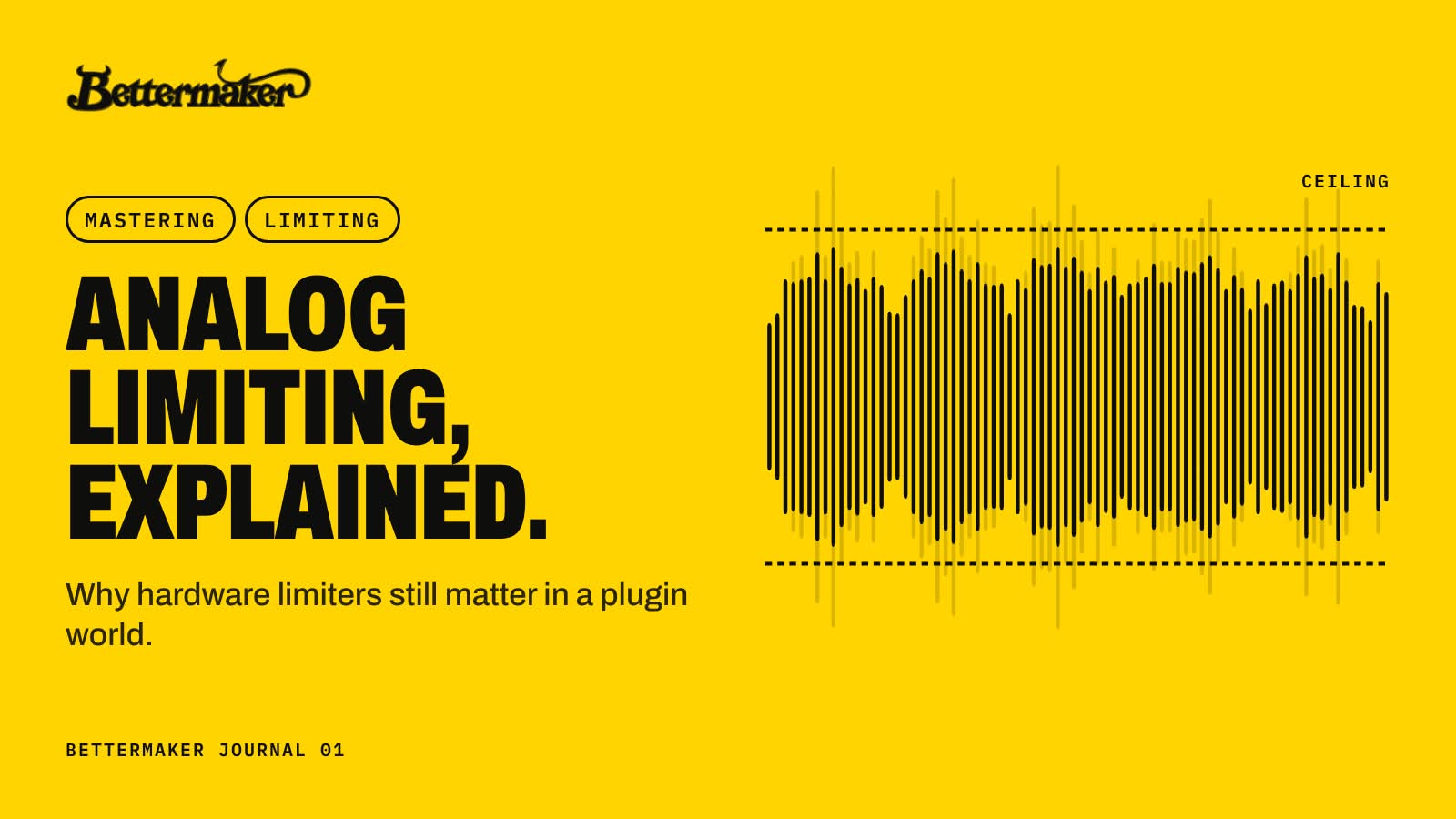
A limiter is a compressor with a very high ratio and a fixed ceiling. Any peak that tries to cross the ceiling is turned down, and everything below it passes untouched. Because the peaks no longer set the maximum level, you can raise the whole track and it sounds louder without digital overs.
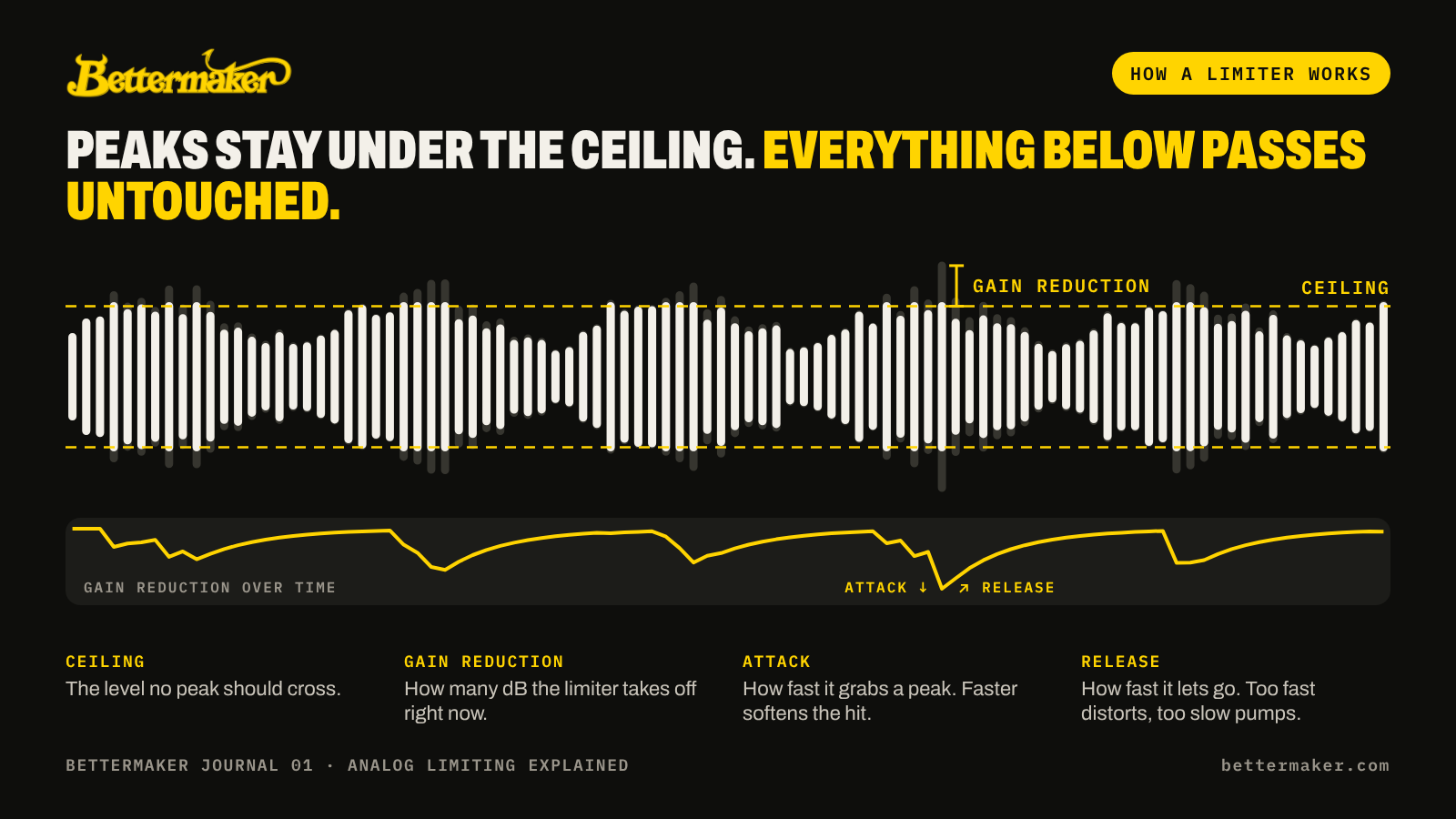
Four controls decide how a limiter sounds:
Ceiling (threshold): the level no peak should cross.
Gain reduction: how many decibels the limiter is taking off at a given moment. A little is transparent; the more you take, the more you hear it.
Attack: how fast the limiter grabs a peak. Fast attack catches more, but softens the transient.
Release: how fast it lets go. Too fast and you hear distortion on bass; too slow and the mix pumps.
Loudness is not free. As mastering engineer Ian Shepherd puts it, "The harder you push any kind of clipping or limiting, the more compromise there inevitably is." The craft is in choosing where that compromise happens, and that is where analog limiting earns its place.
Analog vs digital limiting: what is the difference?
The main difference is time. A digital limiter can look ahead: it delays the audio by a few milliseconds, sees the peak coming and turns the gain down before it arrives. An analog limiter works in real time. It reacts as the signal arrives, so the very front of a transient is shaped by the circuit rather than removed by an algorithm.
That gives each approach a different strength:
Digital look-ahead is precise. Dave Kutch of The Mastering Palace says "Plug-ins have better read-ahead capabilities for allowing transients to pass through compared to analog compression." Pushed hard, though, a digital brickwall tends to flatten transients and the master starts to sound small and loud.
Analog limiting rounds peaks instead of slicing them, and the circuit adds harmonics. The result reads as denser and louder at the same measured level. It is the reason many top rooms still route the master out of the computer. As Gavin Lurssen of Lurssen Mastering describes his workflow: "The tape, or the digital file, gets converted so that we can do our processing in the analog domain."
Joe LaPorta of Sterling Sound, whose credits include David Bowie and Foo Fighters, puts the goal simply: "Every mix has its own potential loudness." He adds that he tries to "keep it analogue whenever possible." Analog limiting is a way to reach that potential without losing the groove.
The best results usually come from combining both worlds. That is the idea behind hybrid mastering, and behind the chain described next.
The professional loudness chain: limiter, clipper, converter
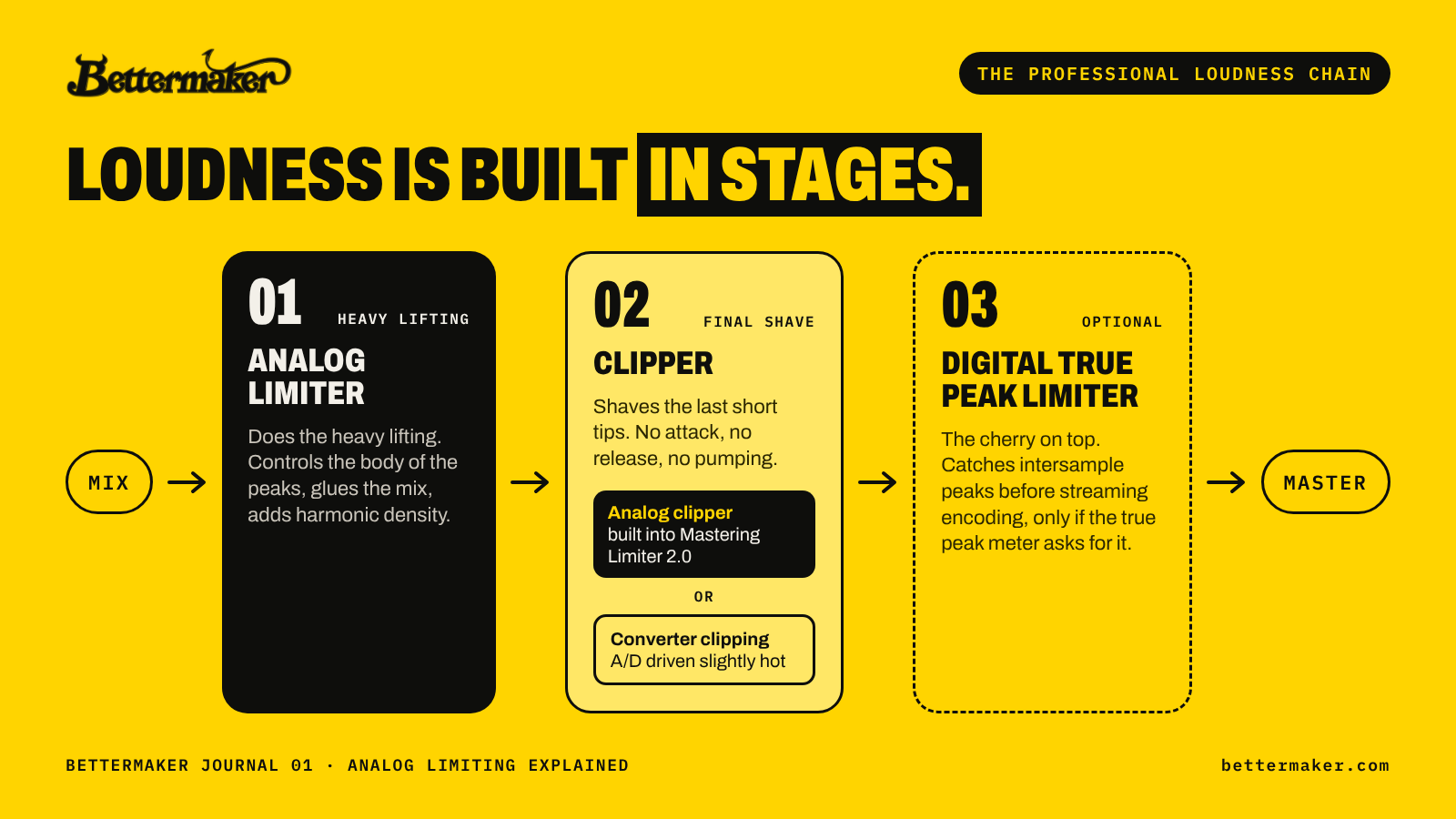
Professionals rarely ask one processor to do all the work. Loudness is built in stages, each taking a small, clean bite:
Analog limiter. Does the heavy lifting: controls the body of the peaks, glues the mix and adds harmonic density. Typically a few dB of gain reduction.
Clipper, or converter clipping. Takes off the last, very short peaks that a limiter would have to pump to catch. A clipper has no attack or release, so it does not move the groove; it simply shaves the tip of the waveform. Two routes are common:
A dedicated analog clipper. The Bettermaker Mastering Limiter 2.0 has one built in: a clipping stage with two independent clipper sections and a trim control, in the same box as the limiter.
Clipping the A/D converter on purpose, by driving it slightly hot on the way back into the computer. Some converters are built for it: Burl invites users to "Push the Bomber into the red for pure analog distortion", while Lavry Gold converters offer a soft saturation mode.
Final digital limiter (optional). A transparent true peak limiter at the end of the chain catches intersample peaks before the file is encoded for streaming. It is the cherry on top, not a requirement: if the analog stages already deliver the loudness and the true peak reading is safe, it can stay off.
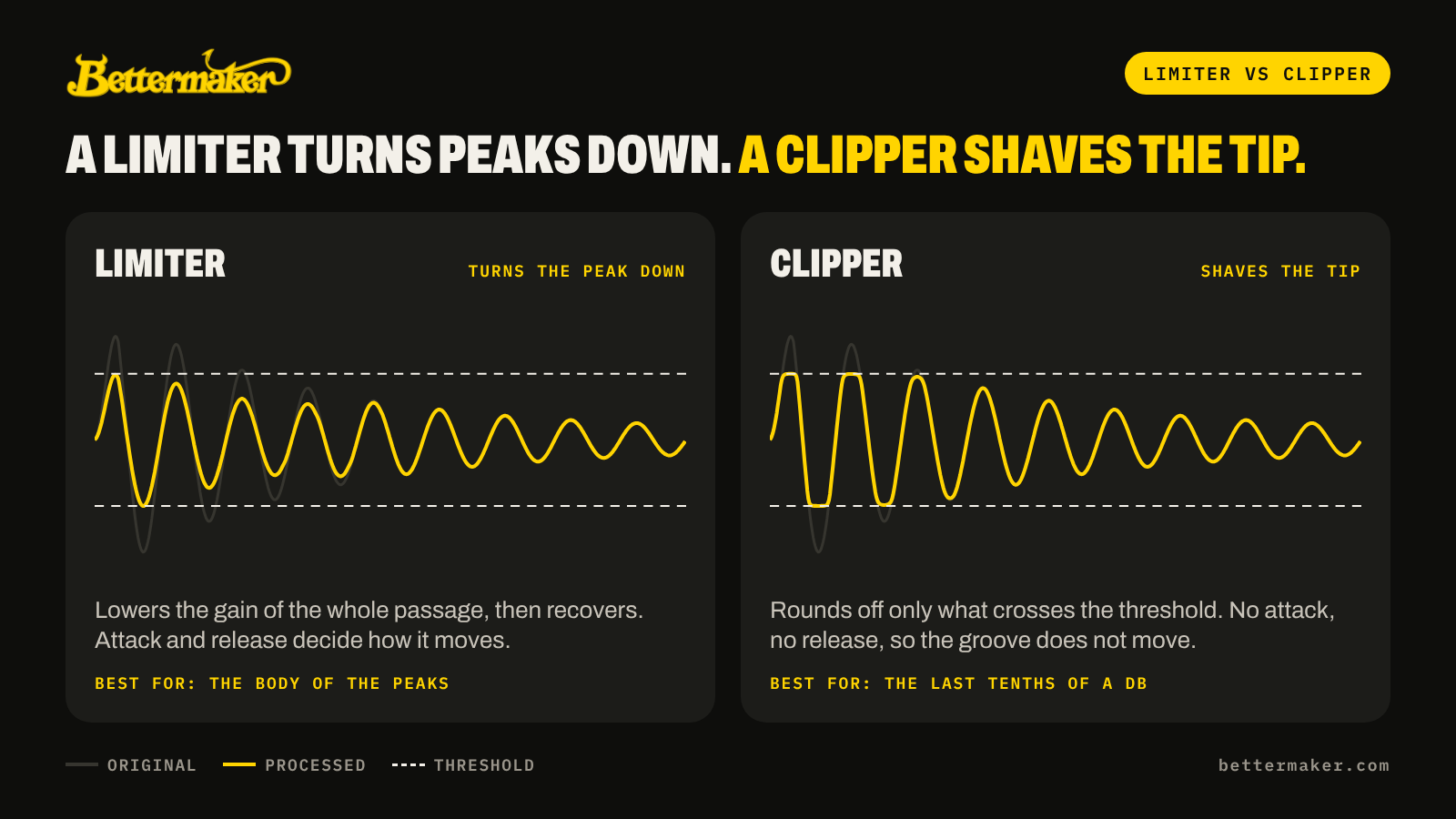
Why a clipper and not more limiting? Ian Shepherd sums up the trade-off: soft analog clipping "gives smoother, more 'musical' sounding distortion, and retains more 'punch' or thump." A limiter is the better tool for the body of the peaks; a clipper is the better tool for the last tenths of a dB.
One technical note on converters. Not every form of converter clipping is analog. Lavry describes its soft saturation as "a form of digital signal processing that produces a result similar to analog tape saturation", applied after the signal is digitized. Transformer and Class A converters like the Burl clip in the analog stage. Both work; they simply sound different, so it pays to know which one you are driving.
Streaming loudness and true peak: is a final digital limiter required?
No, but you need to measure. Streaming services turn loud masters down, so extra loudness buys less than it used to. Spotify normalizes playback to "-14 dB LUFS, according to the ITU 1770 standard" and asks for a true peak below -1 dBTP. If your master is louder than -14 LUFS integrated, Spotify recommends keeping true peak below -2 dBTP, because lossy encoding (Ogg Vorbis, AAC) can add distortion on hot peaks.
True peak is the level between the digital samples, after reconstruction. It can sit above the sample peak your DAW shows. Bob Katz, author of Mastering Audio, is direct about it: "Over 0 dBFS can certainly create distortion." His advice: "You should look at true peak on an ITU or R-128-compatible meter."
So the rule is simple:
If the analog limiter and clipper already deliver the loudness and the true peak meter reads safe for your target, you are done.
If the true peak is too hot, a transparent digital true peak limiter at the very end fixes it with a fraction of a dB. That is its job: a safety net, not the sound.
How to set up a hardware limiter: Mastering Limiter 2.0 step by step
The Bettermaker Mastering Limiter 2.0 keeps the whole loudness stage in one 2U unit: a 100% analog signal path with digital control, an analog limiter, a clipping stage, two saturation modules and full DAW recall. A practical starting point:
Start light. Set the input (0 to +20 dB) so the limiter only touches the loudest hits. Build up gain reduction slowly; the unit allows up to 20 dB, but a master rarely needs that much.
Keep the low end from driving it. Switch on the sidechain high-pass filter (20 to 200 Hz) so kick and bass do not trigger constant gain reduction and pumping.
Choose the release. Use the intelligent release mode as a default, or the BPM-based release to lock recovery to the tempo of the song. Manual release runs from 2 ms to 2 s.
Shape the attack. The range is 0.1 to 250 ms. Slower settings let more of the transient through; faster settings give tighter control.
Add the clipper. Bring in the two clipper sections and use the trim to shave only the tips that are left. Listen to the kick and snare: when they start to sound blunt, back off.
Add color if the track asks for it. Color 1 emphasizes mainly odd harmonics, Color 2 mainly even harmonics, and both can run at once. Use the M/S mode to treat the center and the sides differently. Watch the gain reduction: the Color section sits before the limiter, so added saturation can raise the level going into it and increase gain reduction. After switching Color on, check the gain reduction meter again and lower the input if needed. A simple workflow: set Color first, then dial in the limiter.
Measure. The touchscreen shows LUFS, K-System, VU, PPM, RMS and peak metering, plus an FFT analyzer, goniometer and correlation meter. Check true peak on the captured file in your DAW.
Save and recall. Store the settings in the internal memory and in the DAW session through the Bettermaker plugin. Every parameter can be automated, so revisions take seconds, not a notebook full of knob positions.
Automating an analog limiter: why it matters
Automation is where a recallable analog limiter stops behaving like classic outboard. On most hardware, a setting is fixed for the whole song. With the Mastering Limiter 2.0, every parameter can be automated from the DAW through the Bettermaker plugin, while the audio stays 100% analog.
In practice that opens moves that used to be impossible in hardware:
Push the input a little harder in the final chorus and ease off in the breakdown, so loudness follows the arrangement.
Change release or attack between a dense drop and a sparse verse.
Bring the clipper in only where the drums need it.
Switch Color on for one section and off for another.
The result is analog tone with the control of a plugin, written into the session and identical on every recall.
Beyond the studio: analog limiting at front of house
The same qualities that matter in mastering matter on a festival stage: punch at high level, no audible pumping and instant recall. That is why the Bettermaker limiter has found its way into front of house (FOH) racks on some of the biggest tours.
Burton Ishmael, FOH engineer for Madonna, Post Malone, Nas, H.E.R. and Lil Baby, runs the Mastering Limiter 2.0 at the end of his master chain. He used it on Madonna's Celebration Tour finale on Copacabana Beach in Rio de Janeiro on May 4, 2024, a free show that drew about 1.6 million people. Describing his Post Malone rig, he explained: "finally it goes through a limiter and I use an analog limiter, which is the Bettermaker." He added: "the Bettermaker does the limiting, I do the soft clipping in there." That is the limiter-then-clipper chain from this article, applied to a stadium. (Mixing A Band)
James McCullagh, FOH engineer on the Backstreet Boys DNA World Tour, also listed the Bettermaker Mastering Limiter in his front of house outboard.
For live work, internal preset memory and USB control mean a limiter setting can follow the show song by song, without anyone reaching for the knobs between numbers.
Analog limiters, clippers and converters compared
Each tool below can take part in the loudness stage. They are not direct rivals: most professional chains combine two or three of them.
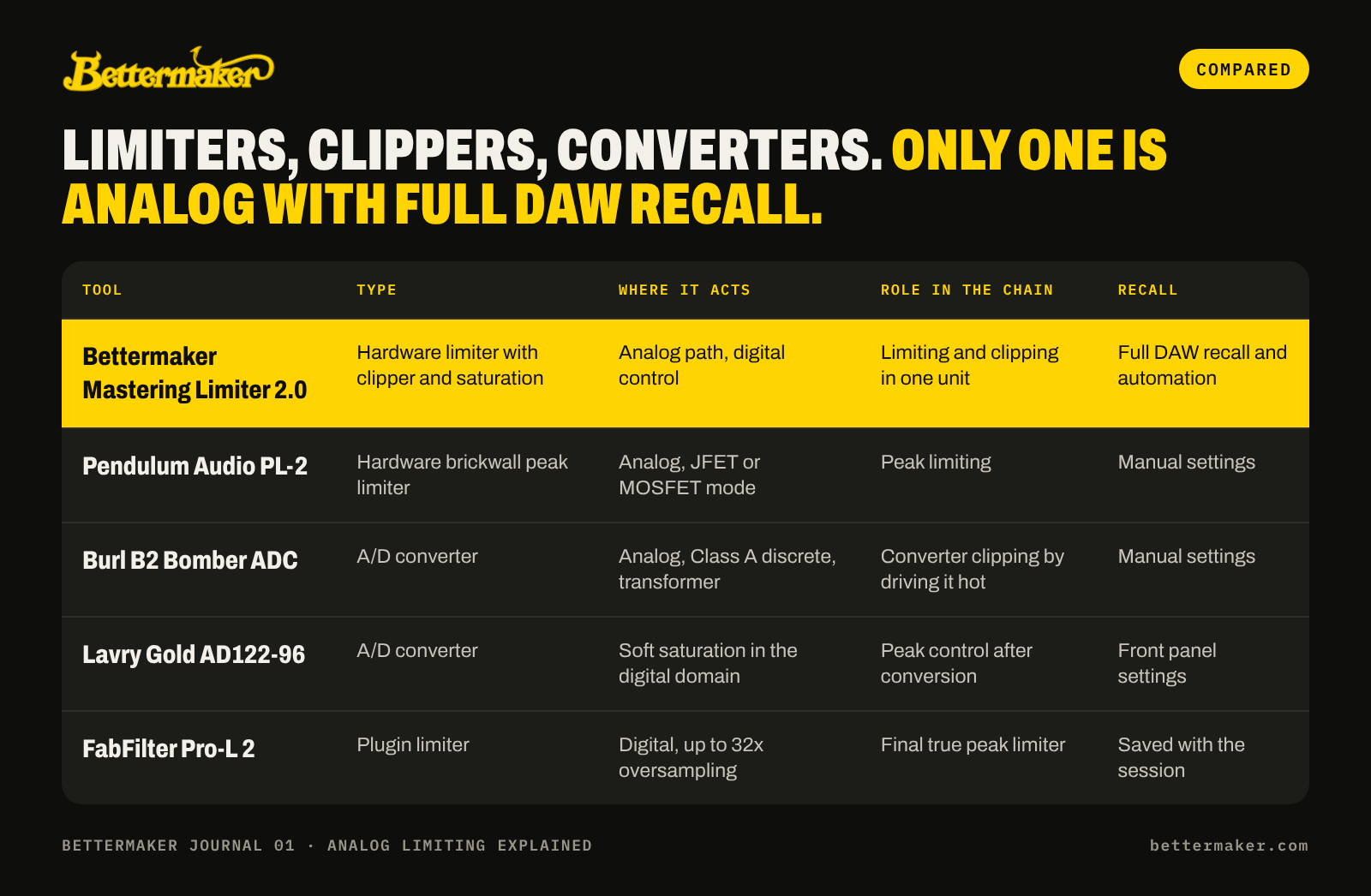
The difference that matters day to day is recall. A hardware limiter without recall sounds great on the first pass and slows down every revision. The Mastering Limiter 2.0 was designed so that analog limiting behaves like a plugin in the session: saved, automated and reset in one click.
FAQ
Is an analog limiter better than a digital limiter? They do different jobs. An analog limiter shapes peaks in real time and adds harmonic density, which keeps punch at high levels. A digital look-ahead limiter is more precise on the very last peaks. Many engineers use analog for tone and loudness and digital only as a final safety net.
Should a clipper go before or after the limiter? In mastering, most professionals limit first and clip last. The limiter controls the body of the peaks; the clipper shaves the short tips that are left without adding pumping.
What does clipping the converter mean? It means driving the A/D converter slightly past its maximum level on the way back into the computer, so it rounds off the highest peaks. Some converters are designed for this, such as the Burl B2 Bomber, which clips in its analog stage, or Lavry Gold models, whose soft saturation works in the digital domain.
Do I need a true peak limiter at the end of my chain? Not always. If your true peak meter already reads below your target, for example -1 dBTP for Spotify, the analog chain is enough. If it reads too hot, a transparent digital true peak limiter fixes it with a fraction of a dB.
How loud should a master be for streaming? Spotify plays tracks at -14 LUFS integrated and turns louder masters down. Master for the sound you want, then check true peak: below -1 dBTP, or below -2 dBTP if the master is louder than -14 LUFS.
Can I recall an analog limiter like a plugin? Yes, if it has digital control. The Bettermaker Mastering Limiter 2.0 stores presets internally and in the DAW session through its plugin, with automation of every parameter.
Can a mastering limiter be used live, at front of house? Yes. FOH engineers use analog mastering limiters on the master bus for punch at high levels without pumping. Burton Ishmael (Madonna, Post Malone) and James McCullagh (Backstreet Boys) have both used Bettermaker limiters at FOH.
Sources
- Ian Shepherd, Digital and analogue clipping versus limiting, Loopmasters
- Joe LaPorta interview, MusicRadar
- Gavin Lurssen interview, Tape Op
- Dave Kutch, The Mastering Palace and Sonnox plug-ins, Sonnox
- Bob Katz, True peak metering, Digido
- Spotify for Artists, Loudness normalization
- Lavry Engineering, Soft saturation
- Burl B2 Bomber ADC, Product page at Vintage King
- Pendulum Audio PL-2, Review in Tape Op
- FabFilter Pro-L 2, KVR Audio product page
- Bettermaker Mastering Limiter 2.0, Official product page
- Burton Ishmael, Post Malone FOH rig rundown, Mixing A Band, and Profile, FOH Online
- Madonna in Rio, 1.6 million fans on Copacabana, NPR via HPPR
- James McCullagh, Backstreet Boys DNA World Tour production profile, FOH Online